How to Do an Off-Ice Warm-Up
 When it’s time to warm up off-ice, most skaters tend to skip the warm-up completely or just do the bare minimum. This is dangerous. As with any sport, if you jump right in without any warm-up, you greatly increase your risk of pulling a muscle or having an even more severe injury. However, what you do for off-ice warm-up is based on your age and what type of skater you are.
Off-Ice Warm-Up for Recreational Skaters
If you are a recreational (non-competitive) skater under 30 who is most interested in doing basic skating maneuvers and maybe a few spins and jumps, you should be okay just starting off slow skating around the rink. Since you get stiffer as you age, if you’re over 30 I would recommend doing 15 to 20 slow off-ice squats, 20 high-knee raises, 15 ankle raises, and 15 shoulder rolls in your sneakers before getting on the ice. While this is not mandatory, this very minimal warm-up will help get your legs, knees, and shoulders working so you are less stiff when you begin skating.
Off-Ice Warm-Up for Competitive Skaters
For all competitive skaters, it’s always a good idea to do at least a minimal warm-up before you get on the ice. This helps avoid the initial stiffness when getting on the ice and gets your body warm before you do anything vigorous. I would recommend doing at least a minimum of jogging up and down the side of the rink. For a full warm-up, do the grapevine exercise next (cross your feet over back and forth quickly while moving sideways) halfway down the side of the rink and back. Then, do high-knee skips halfway down and back. After that, do 15 to 30 seconds of high-knee running in place. This should at least get your heart rate going and your joints loosened up. If you still don’t feel warm, you can double the length of these exercises or add additional warm-up exercises such as jumping rope and jumping jacks.
Now that your heart rate is up, I would do some dynamic stretching (stretching that incorporates movement), such as front kicks while moving forward, back kicks while holding onto the wall, heel raises, body rolls, and arm circles. These dynamic stretching exercises will help stretch out your muscles while warming them up in the process. While dynamic stretching is more beneficial for warm-up than static stretching (non-movement stretching), I always did some static stretches to help improve my flexibility. By using both static stretching and dynamic stretching for warm-up, I felt looser and avoided injuries.
Cooling Down
Also, keep in mind that cooling down is the best time to do static stretching because your muscles stretch easier when they are warm. Plus, streching during cool-down helps alleviate any soreness you may feel after your workout. I’ll talk more about cooling down in the next article.
Whatever you decide to do, try spending at least a few minutes warming up before skating. It really does help you avoid injury.
Photo Credit:
How to Get the Most out of a Skating Competition
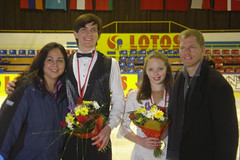
Will Chitwood and Aaryn Smith with Coaches Dalilah Sappenfield and Tom Zakrajsek at the 2005 Baltic Cup JGP in Gdansk, Poland.
Last Friday on RaisingFigureSkaters.com, I wrote a guest post called “How to Get the Most out of a Skating Competition.” My 3 top ideas for getting the most out of a skating competition can be applied to any level of competition and are helpful for both skaters and parents.
How to Lace Figure Skates: An Important Basic Skill
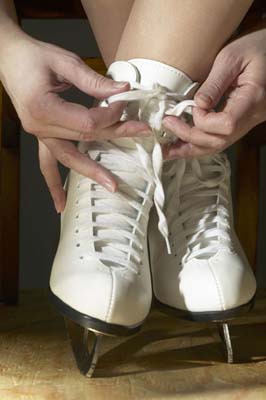
Although lacing figure skates might seem to be a natural skill for anyone who knows how to tie shoes, there are important steps to follow in order to experience the greatest enjoyment and success from the sport of figure skating. Jo Ann Schneider Farris is a Colorado Springs skating coach and writer for About.com: Figure Skating. She has a clear and easy-to-follow article on the important skill of lacing figure skates.
Top 4 Tips Figure Skaters Can Learn from Olympic Gold Medalists Shen and Zhao
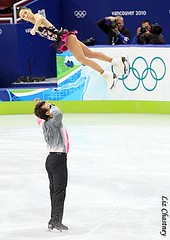
Shen and Zhao's huge split triple twist during their Olympic short program (Photo by Liz Chastney)
2010 Olympic pairs champions Shen Xue and Zhao Hongbo were two of my favorite role models during my early years in pairs. They still are two of my favorite role models. Shen and Zhao demonstrate qualities which make champions as well as people of good character. Following are 4 top tips figure skaters can learn from Olympic pairs gold medalists Shen and Zhao.
1. When a team is a good match, it pays to stay together.
Now married, Shen and Zhao have been skating together for 18 years. This time has helped them develop their strong elements, great unison, and overall polish to their skating. Their dedication helped them become two of the very best skaters in the sport.
2. Focus on turning your weaknesses into strengths.
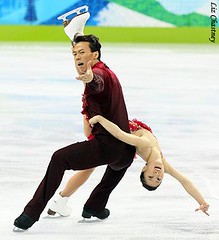
Shen and Zhao during their Olympic long program (Photo by Liz Chastney)
In the past, Shen and Zhao had weaknesses artistically, causing them to earn lower scores than the other top teams. They have worked on improving their expression, artistry, and overall skating skills, giving them an edge over the competition. They combined these skating skills with more advanced choreography to create a strong and elegant style. In addition, they now have good unison and speed in their side-by-side spins, formerly their weakest element.
3. Hard work and dedication pay off.
I remember when my sister and I were training as intermediate pairs competitors in Colorado Springs during October 2000. Shen and Zhao were training at our rink for the upcoming Skate America competition. We were lucky to be able to train on sessions with the elite pairs. Shen and Zhao would skate for the whole session, going from element to element and hardly ever stopping for a break. The work ethic they possessed was the best I’ve seen. Although they are now married, Shen and Zhao have continued to show intense dedication to their skating, even living in separate dorm rooms to train for the 2010 Olympics.
4. Nice guys (people) do finish first.
I’ve only heard good things about what nice people Shen and Zhao are. They have always been very humble and well-mannered. Their sportsmanship has been among the best in the sport, and they have always acted professionally regardless of the competition outcome. Not only are Shen and Zhao great role models for figure skaters, but they are great role models for all athletes.
Top 4 Tips Figure Skaters Can Learn from Olympic Gold Medalists Tessa Virtue and Scott Moir
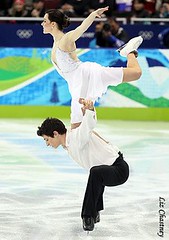
Virtue and Moir had incredible levels of difficulty in their Olympic free dance. (Photo by Liz Chastney)
Tessa Virtue and Scott Moir raised ice dance to a new level this season with technical excellence, innovative moves, and smooth, flowing elegance. They became Olympic gold medalists in the process. Figure skaters can learn much by following Virtue and Moir’s example. The following 4 tips are especially noteworthy:
1. When a team is a good match, it pays to stay together.
Tessa Virtue and Scott Moir teamed up in 1997. The example of Olympic silver-medalists Meryl Davis and Charlie White adds to this point. Davis and White also teamed up in 1997. Two long-standing partnerships had the highest results in the 2010 Olympic ice-dance event.
2. Smooth stroking pays dividends.
Watch Virture and Moir’s stroking throughout their routines to see the flow and grace it gives them between their moves. Stroking is one of the most important fundamentals of figure skating, and this team has used it to propel them to the top of the world.
3. Bend your knees.
Virture and Moir’s knees give them the softness of ballet dancers. They practically float across the ice in their free dance with their movements looking effortless. Their knee bend gives them the ability to incorporate some of the most difficult skating maneuvers into their routines.
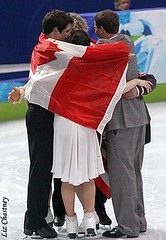
Group hug for training partners Virtue/Moir and Davis/White. (Photo by Liz Chastney)
4. You can be friends with your competitors.
Virture and Moir are close friends and training partners with Meryl Davis and Charlie White. In an interview, Moir said:
I don’t think either of us would be where we are without the other. We help each other on our bad days, and even push it a little more on the good days. To have each other up there on the podium, side by side, it’s amazing. They’re such great people.
I’m sure they wanted to be up on the top of the podium, but they don’t show any of that to us. . . . They’re just such great friends, and they gave us the best hug.
Virtue and Moir are great role models not just for ice dancers, but for figure skaters in general. Which of Virtue and Moir’s qualities do you find most helpful?
Top 3 Training Tips Figure Skaters Can Learn from Olympic Gold Medalist Evan Lysacek
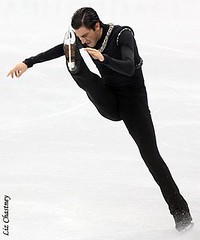
Evan Lysacek during his Olympic long program. (Photo by Liz Chastney)
The 2010 Olympic men’s gold medalist has been a role model for a long time. As the 2009 World champion, Evan was already used to performing on a large stage. Evan’s performance with two clean programs at the 2010 Olympics gave him the distinction of being the first American man to win the Olympics as the reigning World champion since Scott Hamilton in 1984. Evan’s success is obviously not a fluke, and figure skaters can learn important training tips from Evan’s example:
1. Hard work pays off.
Everything I’ve heard about Evan mentions his intense work ethic and drive. He dedicates much of his time to being in peak physical and mental condition. On occasion, his coach, Frank Carol, has told Evan to stop running his program so many times. His hard work really paid off when he became the first American man to win an Olympic gold medal since Brian Boitano in 1988. Evan is celebrating his success by purchasing an Aston Martin DB9!
2. Focus on every aspect of your skating.
Evan has worked hard to develop his overall skating skills. Not only is he a strong jumper, but Evan’s spins, jumps, footwork, and artistry help him be one of the best male skaters in the world. Even though Evgeni Plushenko, the gold-medal favorite going into the Olympics, landed his quad in both the short and long programs, Evan topped his score because of a stronger overall long program.
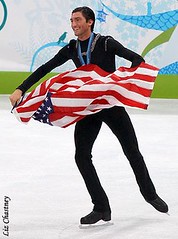
Evan Lysacek after receiving his Olympic gold medal. (Photo by Liz Chastney)
3. Nice guys do finish first.
Evan has a good reputation for being a nice person and shows humility even though he is now the reigning World and Olympic men’s champion. He graciously handled the debate about why he won the Olympics without a quadruple jump in his program. He defended the entire men’s field in his response to Plushenko’s heated opposition after the event:
Nobody likes to lose. . . . Plushenko is a great guy, a great skater. I’ve admired him for years. I thought he did an outstanding job . . . For him to discredit the field, though, that’s not right. It’s probably the strongest men’s field there’s ever been, and I was honored to be in the field.
I guess I was a little disappointed that someone who is my role model would take a hit at me in what is probably one of the most special moments of my life.
Evan’s qualities as Olympic champion are important qualitities to have, not just as a skater but as a person. What do you find to be Evan’s most inspiring quality?

